What we read this week: June 28
“How Phones Alerted Millions Before Quakes Shook Venezuela” (New York Times)
Within 9 seconds of the first quake starting underground, Google’s system had processed phone data and pushed alerts, reaching 11.4 million people before the destructive waves hit.
Android phones detected the initial P-waves while stationary, relayed anonymous data to Google’s servers, and triggered tiered alerts based on shaking severity in each area.
Nearly 1.4 million “Take Action” alerts, the most severe level, were sent to those closest to the epicenter of the 7.2 and 7.5 magnitude quakes.
The system is live in 98 countries, filling gaps where government-operated early warning infrastructure doesn’t exist.
“Oliver Tree Foundation Launches To Assist Artists With “Getting Their Hands Dirty And Creating Things” (Deadline)
Oliver Tree’s estate launched Dr. Oliver Tree’s Extremely Epic Art Grant for Baby Geniuses, awarding grants across music, film, installation, and performance art.
Funds must go toward production, hiring crew or renting gear, not equipment purchases or education.
A board of Tree’s former creative collaborators will vote annually on recipients, with flexibility to fund one large project or several smaller ones.
Tree had publicly stated his intention before his death: “All the money is going to go back to artists.”
“‘Dopamine Sites’: Fake Online Shopping Apps Let You Pretend to Buy Things” (Fast Company)
FoodNeverComes is part of a growing trend of fake online shopping sites spreading from South Korea, where users simulate retail therapy and get the buzz of purchasing something without any financial cost.
The science backs it up: dopamine is released in anticipation of a reward, not when it’s received, meaning clicking “buy” feels good even without a real product attached.
The app was created by a South Korean developer who wanted to help people break the habit of reflexively opening delivery apps out of boredom, not hunger.
Critics on social media called it a sad reflection of late-stage capitalism, while experts caution that dopamine sites feed the behavioral loop either way, just without the financial consequences.
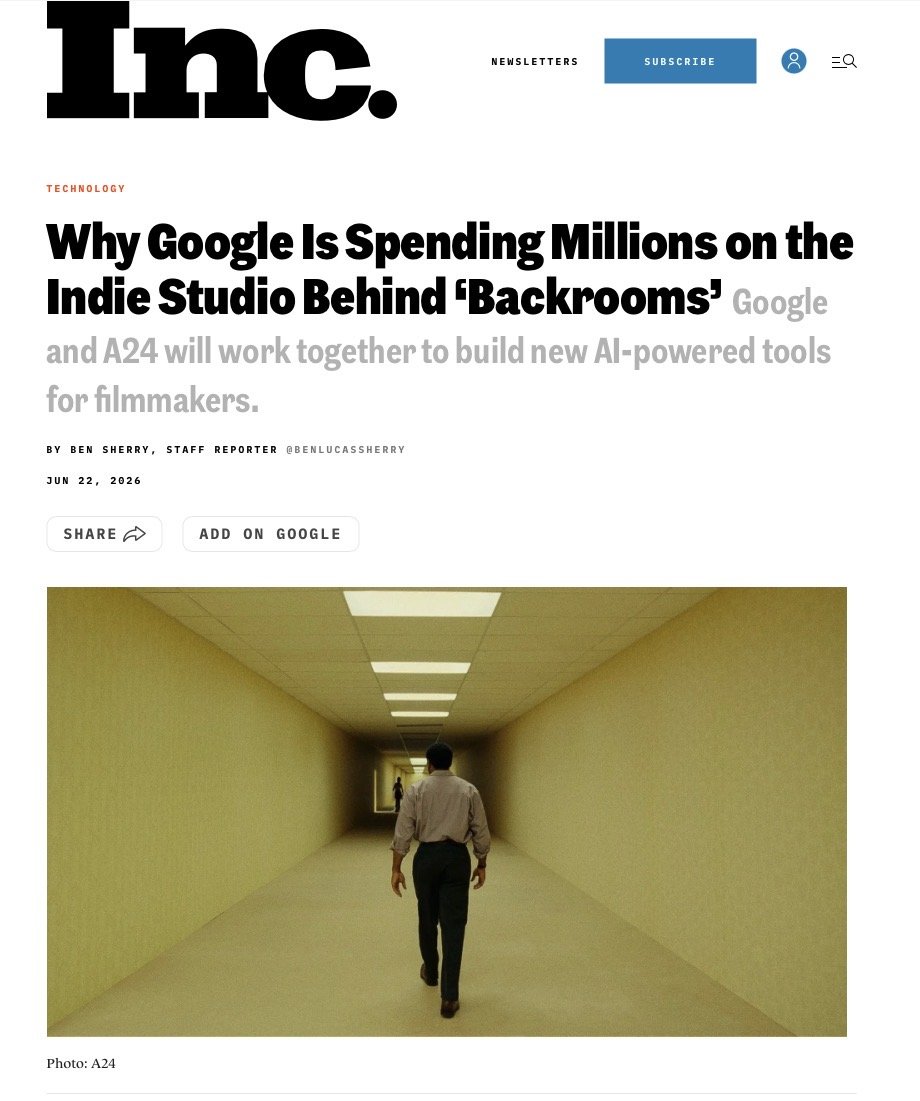
“Why Google Is Spending Millions on the Indie Studio Behind ‘Backrooms” (INC)
Google invested a reported $75 million in A24, its first-ever ownership stake in a film studio to co-develop AI filmmaking tools through a DeepMind partnership.
A24’s film catalogue is explicitly off-limits for model training, and creative control stays with the studio.
A24’s R&D lead noted the collaboration aims to find “better uses of storytelling tech” that preserve creative risk-taking, with specific outputs still to be determined.
Despite the AI partnership, A24 passed on distributing Artificial, a film about Sam Altman dropped by Amazon, signaling the studio is selective about how AI shows up in its brand.
“Creativity strikes back at the Cannes Lions advertising festival” (Business Insider)
Human creativity took center stage this year, with Chipotle’s CMO arguing the industry had become too reliant on optimization and AI shortcuts at the expense of bold ideas.
A Havas study released at the festival found 84% of brands suffer consumer indifference, framing creativity not as a nice-to-have, but a business necessity.
US creator ad spend is projected to hit $44 billion this year, with dedicated creator tracks and spaces at Cannes signaling influencers are now core to brand strategy.
The biggest creators are increasingly operating as full media companies. Issa Rae’s Hoorae Media is landing podcast deals and TikTok micro-dramas, blurring the line between influencer partner and direct competitor to traditional studios.
“Ranch lovers can soon travel with a TSA-friendly kit of the popular American dressing” (Los Angeles Times)
Ranch dressing became one of the unexpected breakout stars of the 2026 FIFA World Cup, with international visitors flooding social media with stunned reactions to the condiment and prompting the TSA to post travel warnings, including a reminder to “avoid chugging your ranch outside security.”
Kraft responded with a limited-edition TSA-Compliant Ranch kit, a clear quart-size bag packed with ranch packets, and a luggage tag shaped like a ranch bottle.
The TSA leaned fully into the cultural moment, writing “Some heroes wear capes. Others bring ranch,” a reminder that the best brand moments are the ones you don’t have to manufacture.
This is a masterclass in reactive marketing: the viral conversation was already happening, and both Kraft and the TSA simply showed up at the right time with the right tone.
Check out our latest blog post: How to Write a Media Pitch for Interior Design, breaking down why the best interior design brands get the press coverage they deserve.
Looking for 1:1 support on brand strategy & media outreach? Book a complimentary consultation with me here - I’d love to meet you!
Xo,
Julia, Che PR Founder