What we read this week: September 20
“Tribeca Is New York’s New Gallery Mecca” (Vanity Fair)
Key Takeaways:
While Chelsea has been New York’s most concentrated gallery district in the past, Tribeca has emerged as the city’s major gallery hub with around 70 major shows opening in September.
This shift has been building as early as 2016, accelerated after the pandemic and major gallerists have established significant Tribeca spaces.
Tribeca is one of Manhattan’s most expensive neighborhoods; however, rent for large ground-floor gallery spaces have remained relatively stable.
The concentration is creating a powerful gallery-going ecosystem, with opening nights creating enormous foot traffic and making Tribeca attractive to collectors, artists, dealers, and the broader art world.
This ecosystem is part of New York’s own cultural reorganization and the surrounding restaurants and social spaces are becoming a part of the art-world infrastructure.
Key Takeaways:
After years of major achievements across music, film, and television, Jennifer Hudson is entering a new chapter.
Nearly two decades after “Dreamgirls” transformed her career and earned her an Oscar, she is now producing the Broadway revival.
During a recent tour, she was inspired to revisit her own songwriting and original music.
On her talk show, she aims to create authentic interviews so viewers can see famous guests as people rather than just public personas, and her interview with Tom Cruise is scheduled to air September 30.
Whether performing, interviewing celebrities, writing new music, or producing Dreamgirls, Hudson is determined to stay true to herself rather than doing what is expected.
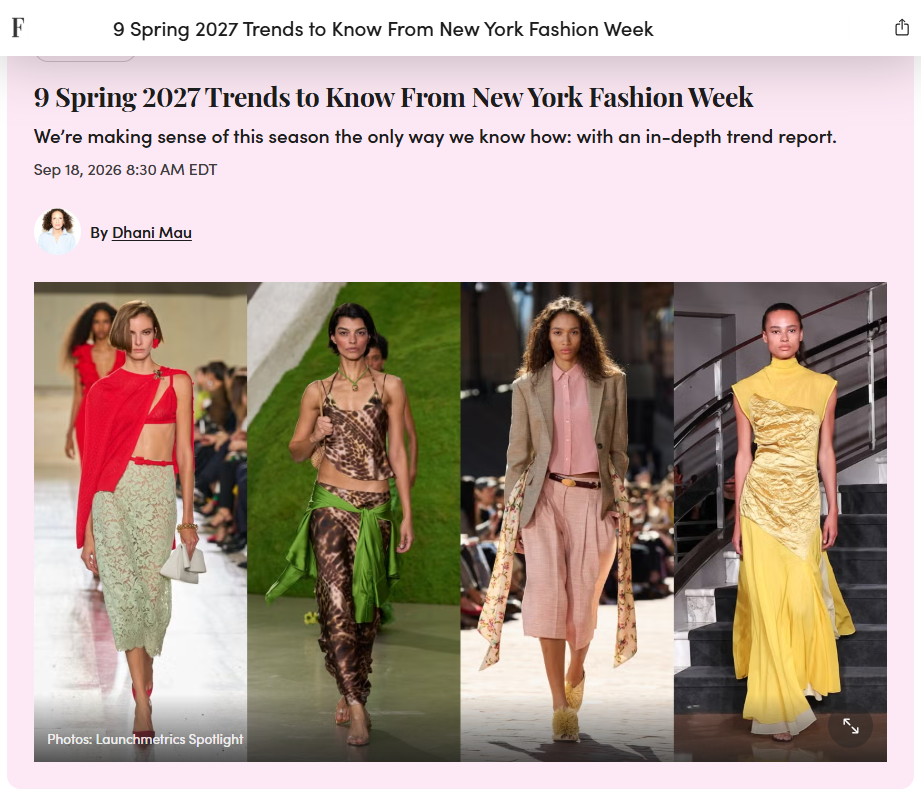
“9 Spring 2027 Trends to Know from New York Fashion Week” (Fashionista)
Key Takeaways:
New York Fashion Week was wrapped up this past Tuesday, but there were some clear standouts of trends.
Low tied clothing is here; for years a sweater or scarf around models’ shoulders followed a usual preppy style, however suit jackets, silk shirts, and scarves are now being styled around models’ waists for a more down-to-earth feel.
Primary colors were all over the runways as designers go back to the basics of red, yellow, and blue.
Spring 2027’s most popular color was marigold; the floral orange-y yellow appeared from Ashlyn and Emily Dawn Long to Carolina Herrera and Michael Kors’ runways.
Sheer skirts make a fun pairing with an otherwise conservative outfit, seen on the Calvin Klein, Eckhaus Latta, and Thom Browne runways.
Skinny, decorative scarves popularized in the 2000s are making a resurgence.
“Matthew Rhys Achieves A Historic Emmys Trifecta” (New York Times)
Key Takeaways:
Matthew Rhys made Emmy history this past Monday, becoming the first actor to win lead-acting Emmys in all three categories: drama, comedy, and limited series.
Rhys took home Lead Actor in a Limited Series for Netflix’s The Beast in Me and Lead Actor in a Comedy for Apple TV’s Widow’s Bay.
Rhys won his first Emmy in 2018 for playing Philip Jennings in The Americans, giving him the drama component of the eventual trifecta.
“Widow’s Bay” was a major Emmy phenomenon: the horror-comedy won 14 Emmys, including Best Comedy Series.
Rhys emphasized gratitude rather than the record.
In his speeches, he expressed surprise at winning, praised his The Beast in Me co-star Claire Danes, thanked Dippold and his Widow’s Bay collaborators, and credited his family for supporting his career.
“Marketing Winners And Loser Of The Week” (AdAge)
Key Takeaways:
The winners of the week include Capri Sun and the Hallmark Channel.
After years of fans joking that Capri Suns seem to be gone in seconds, Capri Sun unveiled their “Big Pouch”, three times as big as the normal size, and will be released for a limited time based on fans' reactions.
Hallmark launched their early holiday/Christmas countdown to capture early seasonal excitement.
The losers of the week include Sydney Sweeney and Pepsi
Sydney Sweeney faced severe backlash and negative consumer pushback for recent stripped down marketing for Novig sports-prediction ads.
Pepsi suffered a misstep with recent campaign clarity with a deliberate “fake name-change” stunt that created more confusion than buzz.
“We’re Living Through An Explainer Epidemic” (Dazed)
Key Takeaways:
Tiktok and Instagram are full of “Thinkfluencers” becoming a major creator category, using tiny microphones, quick edits and explainers to turn psychology, science, culture and other subjects into bite-sized content.
People seem to want social media to feel more meaningful and amid “brain rot” fatigue and loneliness, younger audiences are looking for content that teaches them something or helps them improve their lives.
Book clubs, libraries, lectures, bookstores and other knowledge-oriented spaces are also gaining cultural appeal and learning is becoming something people can participate in together, rather than a solitary activity.
However, the algorithm creates a fundamental tension: platforms reward frequent, short content, while genuinely thoughtful analysis takes time.
The article’s bigger warning is about becoming a commentator instead of a learner - real learning requires slowing down—reading, listening, sitting with other people's ideas and resisting the pressure to immediately turn everything you learn into content.
Looking for 1:1 support on brand strategy & media outreach? Book a complimentary consultation with me here - I’d love to meet you!
Xo,
Julia, Che PR Founder