What we read this week: May 10
“Spirit Airlines Shutdown: Inside the Airline's Final Days and Wind-Down Strategy" (PRWeek)
Takeaways:
Spirit's shutdown was not improvised, the airline had a documented wind-down plan developed at the very start of its restructuring, executed with FTI Consulting, and designed to maintain control and avoid a chaotic, unmanaged collapse.
Timing and information control were central to the wind-down strategy: leadership deliberately delayed notifying service providers until the last possible moment, fearing that early leaks would trigger an uncontrollable shutdown before passengers and crews could be safely grounded.
Communications experts with airline backgrounds argue that surging jet fuel costs from the Iran War were the accelerant, not the cause. The real culprit was a decade of systemic leadership failures and poor long-term planning that left Spirit with no buffer when conditions deteriorated.
Spirit's collapse offers a cautionary blueprint for ultra-low-cost carriers: industry veterans advise ruthlessly cutting unprofitable routes and building fuel cost contingencies into strategy, noting that airlines live and die by a cost, jet fuel, they can never control.
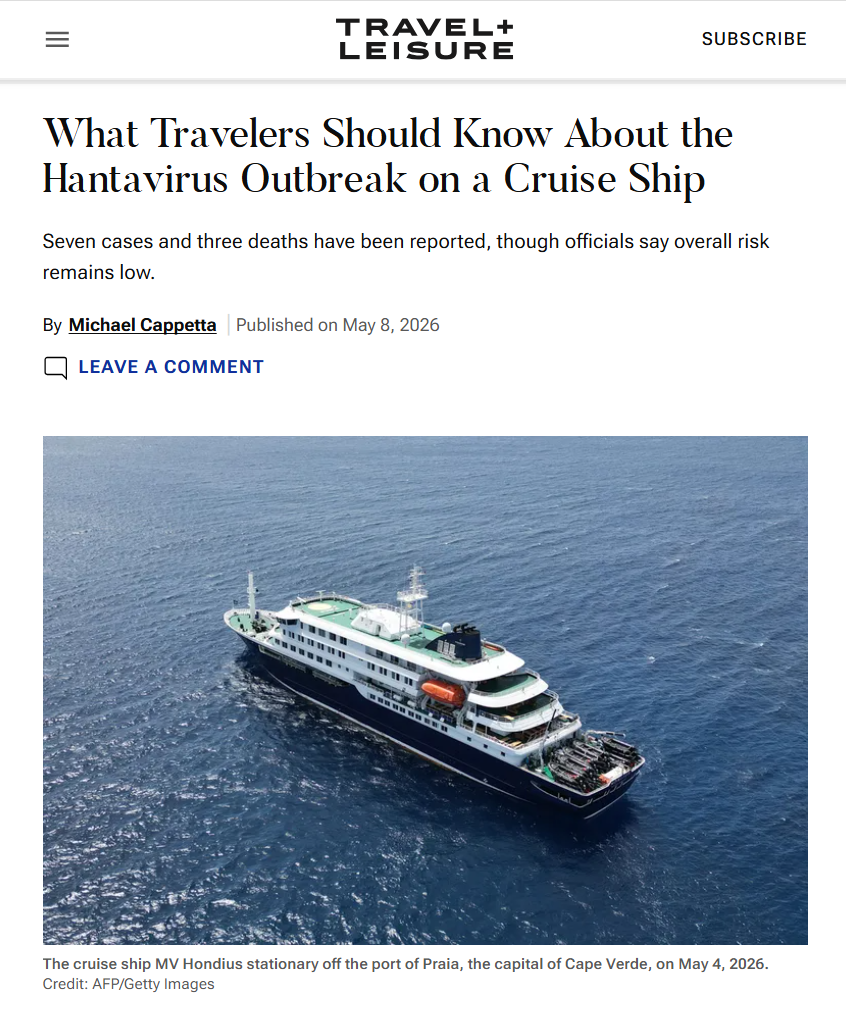
“Hantavirus Cruise Ship Outbreak: What Travelers Need to Know" (Travel + Leisure)
Takeaways:
A deadly hantavirus outbreak on the cruise ship M/V Hondius (which departed Argentina on April 1) has resulted in seven confirmed cases and three deaths as of May 4, marking an unprecedented occurrence of the virus on a cruise ship.
The Andes strain involved is particularly concerning due to its documented capacity for human-to-human transmission and a fatality rate of up to 50%, though the WHO currently assesses the global risk as low.
The outbreak has already crossed borders, a passenger who later died briefly boarded a KLM flight in Johannesburg, triggering international public health notifications across the Netherlands.
For travelers, the practical takeaway is straightforward: avoid rodent-infested areas in South America, and steer clear of close physical contact or shared items with anyone potentially infected, as the incubation period can stretch up to 42 days.
“The Miami Grand Prix Is More Than Just a Formula One Race — It's a Spectacle" (NBC Miami)
Takeaways:
Despite launching only in 2022 on a track built through parking lots, the Miami Grand Prix has rapidly cemented itself as one of F1's most coveted events, winning back-to-back Promoter of the Year awards.
The event's strategy is rooted in translating Miami's culture glitz, food, music, and neighborhood identity, into a "Disney-like" fan experience that no other F1 race attempts to replicate.
Celebrity draw is treated as a deliberate, collaborative effort between the GP and F1 teams, not a happy accident, with the on-track product positioned as the primary magnet for A-listers.
A 10-year contract extension through 2041 signals F1's confidence in Miami's model, even as the event's biggest logistical challenge remains building and dismantling the track around Hard Rock Stadium's relentless year-round schedule.
“Met Gala 2026: The Artworks That Inspired the Red Carpet Looks” (ELLE Decor)
Takeaways:
The 2026 Met Gala theme "Fashion Is Art" gave celebrities an unusually wide creative brief, organized around three body categories (classical, overlooked, and universal), resulting in one of the most conceptually diverse red carpets in recent memory.
Many attendees treated the theme literally, sourcing direct visual references from specific artworks: Rachel Zegler channeled The Execution of Lady Jane Grey, Kylie Jenner echoed the Venus de Milo in Schiaparelli, and Ben Platt riffed on Seurat's pointillist masterpiece.
Bad Bunny's choice to appear as an elderly version of himself was one of the night's boldest conceptual swings, using costume and prosthetics to embody the "overlooked body" category, aging, rather than defaulting to glamour.
The gala quietly signaled a broader cultural shift: fashion's increasing appetite to legitimize itself through fine art references, with designers and celebrities alike leaning on art history as a styling language rather than a novelty.
“BookTok Made Reading Cool Again — But It Also Turned Authors Into Content Creators” (Mashable)
Takeaways:
BookTok has fundamentally rewritten the rules of book marketing. The #BookTok hashtag has surpassed 78.7 million posts, and the platform is widely credited with driving a record 821 million books sold in 2021 alone.
Authors are now expected to be full-time content creators, with publishers increasingly offloading promotional responsibility onto midlist and quiet-title authors who don't receive meaningful marketing budgets.
Viral followings don't reliably convert to book sales, author Emma Noyes built 150K followers, parlayed that into a $500K+ publishing deal, then watched her books underperform because her audience followed her for lifestyle content, not her writing.
The algorithm's narrow preferences mean social media success remains closer to gambling than strategy, and even established BookTok authors caution newcomers not to conflate platform growth with a viable path to readership.
Curious about how travel brands earn coveted media placements? Our latest blog, "Travel PR 101: How to Get Your Property or Destination Featured in Top Travel Media,” breaks down exactly how we do it.
Looking for 1:1 support on brand strategy & media outreach? Book a complimentary consultation with me here - I’d love to meet you!
Xo,
Julia, Che PR Founder