What we read this week: May 31
"Hooters Says Bring the Kids"(New York Times)
After filing for bankruptcy, Hooters' original founders reacquired the brand and are now repositioning it as family-friendly, proof that a rebrand born from crisis can still carry strategic ambition.
CEO Neil Kiefer frames the pivot not as a departure from identity, but a correction of drift wanting to return Hooters to "a beach-themed place centered around the Hooters Girls, good food, and an easy place to relax."
Changes to uniforms and menu aim to make the brand feel welcoming to "everybody" with "no one being insulted" a telling phrase that acknowledges exactly what the old brand communicated and the reputational weight this rebrand has to carry.
When a brand's identity is its biggest liability, leaning into legacy is a gamble. The market will decide whether Hooters' tension between nostalgia and reinvention reads as charming or incoherent.
"Ciara, Amanda, West, and What It Means to Date in White Spaces As a Black Woman"(Vogue)
Ciara Miller didn't want to be seen as an experience or something to try she wanted to be viewed as a viable partner. That distinction between being desired and being taken seriously is one the Summer House scandal made impossible to look away from.
Amanda Batula's defensiveness at the reunion betrayed her real belief, that she considered herself a better match for Wilson than Miller was. It's a dynamic Black women in white spaces know well: the feeling that no matter how present or loyal you are, you're never quite the default choice.
West Wilson did what many white men in his situation do: sat there and evaded any questions that made him uncomfortable, letting Batula take all the heat, a quiet but telling abdication that said more than anything he could have answered.
Black women in media have long been relegated to a supporting role the shoulder to cry on, the sassy comic relief, the support system, when they have always deserved to be the main character in their own love stories.
#CHEclient "New Sushi Bar Adds to Wrightsville Beach Restaurant Experience"(Port City Daily)
Shark Bar launched The Red Cat Sushi Bar on its second floor, with chef Louie Sipler calling the craft "an art form" that has pushed his culinary range further expansion doesn't have to mean dilution when the throughline is craft.
The concept leans directly into its location: diners sit upstairs overlooking the ocean and eat fish caught in those same waters sometimes just hours before the kind of provenance story no marketing budget can manufacture.
Red Cat opens at 3 p.m. daily with half-off sushi until 5 p.m. making a premium concept accessible from the jump, smart for building local regulars before tourist season peaks.
The menu blends modern sushi classics with a Carolina twist alongside original chef creations, a model for any brand entering a new category: root it in what's already trusted, then give it a reason to stand apart.
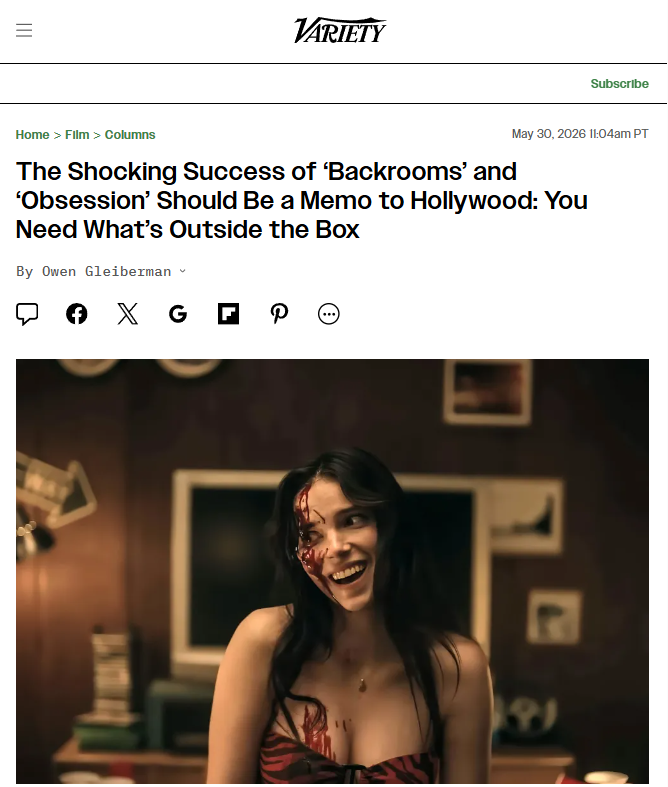
"'Backrooms' and 'Obsession' Offer a Memo to Hollywood"(Variety)
Both films were released by independent companies Backrooms by A24, Obsession by Focus Features, and Variety's Owen Gleiberman argues their success undermines the industry-wide fear about the future of theatrical, suggesting A24 is entering its full Miramax era with a chance to bend the culture.
The real lesson from both films isn't just that YouTube-famous directors sell tickets, it's that audiences will show up when movies surprise them, go around forbidden corners, and tap into new ways of seeing rather than retreading familiar ground.
Obsession works because it taps into actual generational anxiety a fantasy romance that spirals into compulsion and mental illness, with real-world terror lurking inside the premise. That's the formula: take something emotionally true and wrap it in something nobody's seen before.
Gleiberman's argument extends beyond film: if you delay the home release, they will come and mostly, what's needed is a return to making things people seek out because they want to be surprised. For any industry struggling with audience attention, that's the memo.
"Should Your Home Have Its Own Merch?"(Architectural Digest)
House merch (custom postcards, coasters, matchbooks, and stickers gifted to guests) is a growing trend that treats the home like a boutique hotel, turning hospitality into a branded, memorable experience.
The trend taps directly into a Gen Z rejection of mass-market sameness: PwC found young people are actively seeking products "that feel personal, not mass-produced," and nothing is more personal than something you can only get from someone's home.
It also aligns with the analog movement, the desire to create something physical and offline in a world of DMs and digital noise. Designing your own house merch is, as one creator puts it, "arts and crafts without the stress."
The barrier to entry is low (Canva, Sticker Mule, Zazzle), but the payoff is high: house merch creates a tangible connection between host and guest that no text or post can replicate and for communicators, that's the whole ballgame.
Check out our latest blog post: "How Entertainment Brands Use Experiential Marketing to Create Buzz" breaking down why the best activations don't just get people talking, they get people posting.
Looking for 1:1 support on brand strategy & media outreach? Book a complimentary consultation with me here - I’d love to meet you!
Xo,
Julia, Che PR Founder