What we read this week: may 3
“The Glamorous Growth Strategy of Flamingo Estate” (Inc.)
Takeaways:
Flamingo Estate's growth isn't built on celebrity connections alone — founder Richard Christiansen writes every Instagram post and newsletter himself and refuses to outsource that creative work, calling it "the biggest window to your thoughts and your world."
The brand originated as a pandemic-era act of community: Christiansen began selling a local farmer's produce to prevent her from losing her property when restaurants shut down, and described the work as bringing a joy he hadn't felt in years.
Nature positioned as luxury is the brand's foundational thesis and at least one family-owned luxury fashion house is in discussions that could result in an acquisition.
The central tension the story surfaces: a brand built on radical intimacy and founder-led authenticity is now tracking toward $75M in revenue, and the challenge of scaling without losing exactly what made it desirable is very much unresolved.
"Should We All Start Smoking Cigarettes Again?" (The Cut)
Takeaways:
Writer Xochitl Gonzalez frames her creeping desire to smoke again not as a health calculation but as a response to political chaos and ambient dread, a reassessment of what it means to "preserve" oneself for a future that no longer feels assured.
The essay's nihilism is explicit: when forever chemicals are in the soil and geopolitical catastrophe feels imminent, the logic of self-denial starts to collapse "is there really a point in sacrificing a quick thrill in the now?"
The piece is less about cigarettes and more about the psychology of deferred pleasure, what we give up, for whom, and whether the trade still makes sense.
It connects to a broader generational mood: a longing for the rituals, spontaneity, and social texture that a cigarette break once provided, friction that frictionless modern life has largely eliminated.
"Is the Future of Shopping Hiding Inside Luxury Hotels?" (Business of Fashion)
Takeaways:
Young consumers are increasingly prioritizing experiences over possessions, a shift that has contributed to the luxury slowdown and reshuffled the status symbol hierarchy, prompting some retailers to embed themselves inside hotels where shoppers are already in a discovery mindset.
MML Hospitality is inverting the typical model: rather than fashion brands seeking hotel partnerships, they're expanding luxury boutique, ByGeorge, into new markets by placing it inside their own properties and operating the retail floor with a concierge approach, with new outposts opening in Aspen and New York this year.
The hotel-as-retail-channel reframes shopping as ambient and curated rather than transactional, borrowing the trust and atmosphere of hospitality to lower consumer resistance and create a sense of discovery.
The deeper implication: as standalone retail struggles for foot traffic, the future of physical commerce may increasingly live inside spaces people already want to inhabit.
"Chicago's first purpose-built production studio gets creative while Illinois works to draw Hollywood to the state" (Chicago Business Journal)
Takeaways:
Illinois raised its film production tax credit from 30% to 35% and layered on additional incentives for local hiring and environmentally sustainable productions. State officials now claim it offers more competitive terms than any other state, including California.
Production spending hit a record $703 million in 2025, a 25% jump over pre-pandemic levels, supporting an estimated 18,000 industry hires on productions including Chicago Fire, The Bear, and The Chi.
Our client, The Fields Studio is a 23-acre creative media campus located in Chicago, and is the kind of infrastructure that turns a tax incentive into a genuine reason to stay.
The story is part of a national reshuffling: as Los Angeles continues losing production to runaway filming, states like Illinois are aggressively competing for Hollywood dollars, with meaningful consequences for local labor markets, real estate, and regional identity.
“How to Shop Vintage for Mother's Day Gifts" (Architectural Digest)
The article repositions vintage not as a budget alternative but as an aspirational act of individuality.
Provenance and seller transparency are framed as the entry point to any purchase, establishing ownership history through receipts, auction records, maker's marks, and hallmarks is presented as both a practical and meaningful part of the gifting process.
The categories spotlighted, 19th-century American quilts, British ceramics, sterling silver, Victorian lockets, and midcentury Murano glass. They each share a common thread: objects designed for daily use that deepen over time.
The piece implicitly argues against the disposability of contemporary gifting. Vintage objects arrive already carrying history, making them inherently more personal than anything newly manufactured.
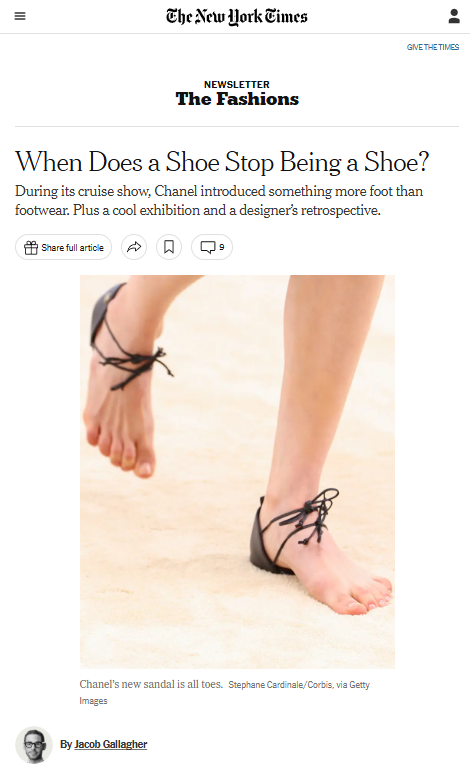
"When Does a Shoe Stop Being a Shoe?" (The New York Times)
Chanel's Cruise 2027 collection debuted a sandal that appears deliberately unfinished, material covering only the heel, held by two tied straps, which the brand described as a "barefoot heel cap," intentionally incomplete by design.
Creative director Matthieu Blazy framed the collection as a homage to Chanel's 1920s style codes, drawing from sportswear, workwear, and sailors' uniforms the half-shoe sits within a broader design philosophy of reduction and restraint taken to its logical extreme.
The public reaction was immediate and split: social media users called it everything from a "recession indicator" to a design that prioritizes concept over comfort.
The piece raises a genuinely interesting question about fashion's relationship to function: at what point does deconstruction become the product itself — and who gets to decide when an object has crossed the line from shoe to idea?
Curious about what that looks like behind the scenes? Our latest blog, "What Does a Boutique PR Agency Actually Do?" is your inside look at the Che PR approach.
Looking for 1:1 support on brand strategy & media outreach? Book a complimentary consultation with me here - I’d love to meet you!
Xo,
Julia, Che PR Founder
Xo,
Julia, Che PR Founder