What we read this week: April 26
“The Devil Wears Prada Inflation Index” (The Cut)
Takeaways:
The article reconstructs 2006 prices using Vogue captions, newspaper archives, and vintage PurseBlog forum posts,making it as much an exercise in economic archaeology as fashion journalism.
The article uses the film's iconic wardrobe as a lens to examine broader luxury inflation, revealing that what once felt aspirational-but-attainable has become genuinely out of reach for most people, even as the sequel arrives and nostalgia for the original peaks.
The timing of the piece, timed to The Devil Wears Prada 2's release, underscores how pop culture moments create natural openings to examine economic realities. In this case, two decades of unchecked luxury price growth.
"Twenty-Nine Unmissable Highlights at Milan Design Week 2026" (Dezeen)
Takeaways:
Cross-cultural exchange is a defining theme. From the Uzbekistan Art and Culture Development Foundation's craft-forward debut to S-3, a new platform connecting East Asian design to global audiences through an exhibition entirely dedicated to chopsticks.
Politecnico di Milano students are staging one of the week's most provocative moments. Using the White House as a case study in domestic propaganda, examining how its interiors have been used to project political power across presidencies.
The big structural news at the fair is the launch of Salone Raritas, the first dedicated collectible design exhibition at Salone del Mobile, designed by Formafantasma, a formal acknowledgment that the collectible design market has earned its own platform.
Our founder Julia is on the ground in Milan this week for her first-ever Salone del Mobile, and she's sharing everything she's seeing in real time. Read her full itinerary and picks on the Che PR blog here.
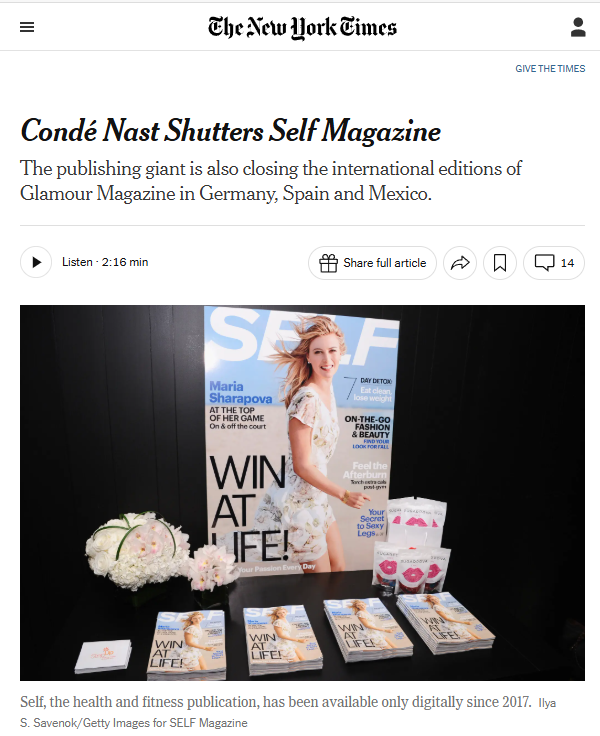
"Condé Nast Shutters Self and Glamour Editions" (The New York Times)
Takeaways:
Despite Condé Nast ending 2025 profitably with revenue growth, CEO Roger Lynch is shuttering Self, Glamour's international editions in Germany, Spain, and Mexico, and Wired's Italian print edition, titles that together represent just over 1% of revenue.
Self's closure after nearly 50 years reflects a stark reality for digital-only publishing: even a fully transitioned, overhead-light brand can't survive when AI and social platforms have demolished the web traffic that once sustained it.
Glamour isn't disappearing, it's narrowing. With Lynch doubling down on the U.S. and U.K. markets and pivoting hard toward social, video, and licensing. The international retreat signals that global scale is no longer a viable strategy for mid-tier magazine brands.
"Is the Ticketmaster Monopoly Verdict a Mirage?" (The New Yorker)
Takeaways:
A federal jury in Manhattan found that Live Nation and Ticketmaster operated as an illegal monopoly, validating years of consumer complaints. But a judge still must determine remedies, including whether to break up the company.
Legal experts caution that meaningful change for concertgoers is far from guaranteed: any remedy ordered by the court would likely be paused during Live Nation's expected appeal, meaning real structural change could be years away.
Even in a best-case scenario, a forced breakup, it remains unclear how long it would take the live events landscape to actually feel the effects, since Live Nation has dominated so thoroughly for so long that competitive alternatives would need time to emerge.
"2026 Digital Media Trends: Capturing Always-On Fandom" (Deloitte)
Takeaways:
Fans are an economically distinct and highly valuable consumer segment: they spend 51 more minutes per day with media and entertainment than non-fans, subscribe to more streaming services, and spend roughly $71 per month on those subscriptions compared to $56 for non-fans.
The media industry is largely built around release moments (premieres, season launches, live events) but fans don't disengage in the off-season. Instead, roughly half say social media is their primary way to stay connected to their fandom year-round, meaning engagement and monetization are currently leaking to third-party platforms.
Around 40% of fans wish they could aggregate all content related to their favorite IP into a single environment. A clear signal that media companies have an opportunity to build more cohesive, year-round ecosystems rather than relying on episodic marketing pushes.
"Travel Trends in 2026 Are About Emotion, Not Destination”(Forbes)
Takeaways:
Emotional intention is now the starting point for trip planning. Travelers begin their search with a vibe or feeling rather than a destination, signaling a fundamental shift in how and why people decide to travel.
Live events have become a primary travel driver with concerts, festivals, sporting events. Hotels are being booked specifically for how well they enhance those experiences.
Social media fatigue and a hunger for human connection are pushing travelers toward bi-generational holidays, communal bathhouses, and human-guided discovery. A collective pushback against algorithmically curated, over-touristed experiences.
Getting familiar with the media outlets you want to be featured in is one of the smartest (and most underrated) moves you can make. But knowing how to show up is just as important as knowing where.
Not sure which PR model is right for your brand? Our latest blog, "PR Retainer vs. Project-Based PR: Which Model Is Right for Your Business?" breaks it all down. Read it before you commit.
Looking for 1:1 support on brand strategy & media outreach? Book a complimentary consultation with me here - I’d love to meet you!
Xo,
Julia, Che PR Founder