“Is Millennial Optimism Back? The Internet Thinks So After The 2026 Midterms” (Mashable)
Key Takeaways:
Following Democratic victories in the 2026 midterms, social media users revived the hopeful, nostalgic energy associated with the Obama era, affectionately dubbed ‘millenial optimism’.
TikTok users are revisiting late-2000s and early-2010s culture through throwback fashion, music, selfies, and internet aesthetics.
The younger generations are romanticizing the era, drawn to the optimism they remember from childhood and the future they imagined, but never fully experienced.
This trend is more than nostalgia, it reflects a longing for a future that feels hopeful, exciting, and full of possibilities, with a strong sense of community and connection.
Democratic wins in traditionally Republican strongholds gave some users a renewed sense that they associated with the Obama years could return.
Songs like “We Are Young,” clips from Hamilton, and references to the “blue wave” have become symbols of this renewed optimism, with Google searches for the phrase reportedly rising 5,000 percent.
“Is Air Travel Getting Less Safe?” (The New York Times)
Key Takeaways:
A recent series of aviation accidents and near-misses has raised concerns about growing pressure on the U.S. air travel system.
Aviation safety depends on many invisible workers and dispatchers, weather specialists, maintenance crews, medical staff, and simulator trainers all play critical roles in preventing accidents.
Decades of training, oversight, redundancy, and a culture of anticipating worst-case scenarios have made commercial flying remarkably safe.
However, air traffic controller staffing remains a longstanding problem and the FAA has struggled to fully staff air traffic control positions for decades.
Aviation safety depends on maintaining strong institutions and a willingness to prioritize precaution over convenience or political interests.
The aviation system may need structural changes with questions about airline deregulation and long-term infrastructure investment pointing to broader challenges facing the industry.
“Everyone’s A Winner In The ‘Call Her Daddy’ Podcast Feud” (The Wall Street Journal)
Key Takeaways:
Sofia Franklyn is revisiting the infamous Call Her Daddy podcast 2020 breakup.
In her new memoir, Daddy Issues, the former Call Her Daddy co-host shares her perspective on the falling-out with Alex Cooper and the end of their friendship and business partnership.
Franklyn says the two disagreed over Barstool Sports' contract terms, compensation, ownership of the podcast, and whether to explore other network offers.
Her experience left her with significant emotional distress, paranoia, and struggles with alcohol and drugs following the public fallout and negative online attention.
In her memoir, she discusses the behind-the-scenes creative contributions of Cooper's friend Muji Fricke and alleges that Cooper's husband threatened legal action over the book, a claim his representatives have disputed.
While Cooper built a major podcast and media business, Franklyn's book has become a bestseller, reigniting public interest in their split and giving her an opportunity to share her side of the story.
“The Joy Of True Mental Effort” (The Atlantic)
Key Takeaways:
Mental effort has its own rewards.
Working through difficult problems can create a sense of satisfaction, excitement, and accomplishment that goes beyond simply finding the right answer.
AI is transforming mathematics and they are increasingly capable of solving complex mathematical problems and producing breakthroughs that once required years of human research.
However, human curiosity still matters with mathematicians finding meaning in exploring abstract ideas, discovering patterns, and understanding the universe, not just producing correct answers.
Collaboration may become more important than individual intelligence and people may find greater value in sharing ideas, working together, and approaching challenges as a team.
The ability to stay curious, tolerate challenges, and enjoy the process of learning may become more valuable than being the smartest person in the room.
“What To See, Hear and Discover At Paris Photo 2026” (Wallpaper)
Key Takeaways:
Photography is celebrating its 200th anniversary.
The 2026 edition of Paris Photo explores photography's evolution from early photographic processes to today's digitally manipulated and AI-generated images.
Thomas Ruff is a major highlight with a 36-meter retrospective featuring more than 40 years of his work that traces the evolution of photography from analog images to digital simulations.
Women photographers are receiving greater recognition and the Elles x Paris Photo program highlights women artists and reexamines photography's history through a more inclusive, global perspective, with women's representation at the fair rising from 20% to 38% since 2018.
AI is challenging how we understand photography and the use of it changes not only how images are created but also how they make us feel.
The celebration extends throughout Paris and exhibitions, artist talks, book launches, and photography installations across the city explore everything and anything.
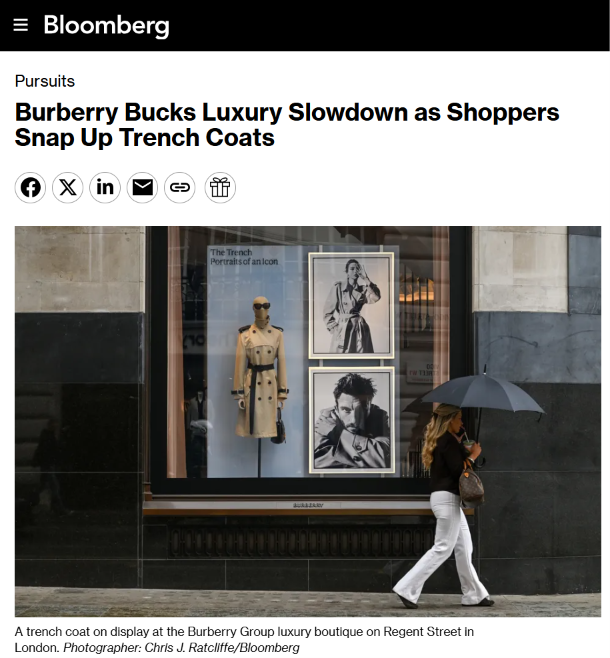
“Burberry Bucks Luxury Slowdown As Shoppers Snap Up Trench Coats” (Bloomberg)
Key Takeaways:
Burberry's turnaround is gaining momentum.
The British luxury brand reported a 6% increase in first-half revenue to £1.1 billion, marking its fifth consecutive quarter of comparable sales growth.
Its iconic trench coats are driving the revival with double-digit growth in outerwear, particularly rainwear and lightweight gabardine jackets, suggesting customers are responding to Burberry's renewed focus on its heritage products.
CEO Joshua Schulman has shifted the brand away from ultra-luxury positioning toward a broader range of price points that appeal to younger and aspirational shoppers.
First-half reported operating profit reached £54 million, compared with an £18 million loss during the same period last year, reflecting stronger sales and cost controls.
Alongside its signature coats and scarves, the company is investing in leather goods, handbags, celebrity-led campaigns, and its recognizable British aesthetic to reconnect with consumers.
“The Rise Of The Gen Z Cinephile” (The New York Times)
Key Takeaways:
Gen Z teens and young adults are increasingly attending theaters, helping bring new energy to an industry still recovering from the pandemic.
Younger audiences are embracing everything from major Hollywood releases to independent films, foreign cinema, and older classics.
The pandemic helped fuel the trend and years of social isolation and watching movies at home appear to have created a stronger desire for shared, in-person entertainment experiences.
Platforms like Letterboxd allow young film fans to review movies, exchange recommendations, discover classics, and connect with people who share their interests.
The big screen, immersive visuals, and collective experience of laughing, reacting, and watching alongside strangers make going to the movies feel special as opposed to streaming.
Young audiences’ growing interest in diverse genres and cinematic experiences is encouraging theaters and studios to rethink programming and how they attract younger moviegoers.
Looking for 1:1 support on brand strategy & media outreach? Book a complimentary consultation with me here - I’d love to meet you!
Xo,
Julia, Che PR Founder