“Canva’s Restructuring Affects More Than 1,200 People. But Its Severance Package Is Earning Page” (Fast Company)
Key Takeaways:
Canva is restructuring its business, affecting nearly 1,300 employees, or approximately 22% of its workforce.
They are taking a new approach to layoffs with every impacted employee receiving six months of salary, regardless of their geographic location.
Employees who joined within the past year will also be able to retain shares they have earned.
Departing employees will retain healthcare coverage and receive résumé assistance, career coaching, interview preparation, and one year of LinkedIn Premium.
Canva is offering $10,000 grants to former employees interested in launching a business, pursuing a project, or supporting a meaningful community initiative.
Many are praising how graceful and humane these layoffs are and departing employees can keep their company MacBooks, access an opt-in alumni talent directory, and receive direct support connecting with future opportunities.
“As Social Media Shoots For Long-Form Should Brands Invest In Creator TV” (Vogue)
Key Takeaways:
Social media is evolving into entertainment.
Platforms like Instagram, TikTok, and YouTube are shifting beyond short-form clips toward longer, episodic, TV-style creator content.
Consumers are increasingly looking for deeper storytelling, meaningful content, and entertainment that feels less disposable and performative.
Instead of chasing individual viral moments, brands have an opportunity to build ongoing content franchises that create stronger audience relationships and long-term relevance.
The most successful creators are developing original shows, recognizable formats, and loyal communities rather than simply producing sponsored influencer content.
Authenticity matters more than expensive production or overly polished advertising.
Brands can build deeper loyalty by creating entertainment around specific cultural interests and fandoms, with examples including StockX's Listed and Figma's Source Material.
“Blue Wave Sweep: What Does Democratic Shift Mean For Hollywood And The Media?” (Variety)
Key Takeaways:
The Democrats’ midterm gains could create a more favorable political environment for the entertainment industry during the final two years of the Trump administration.
Hollywood tax incentives remain a top priority with the industry pushing for federal film and TV production tax credits to keep productions and jobs in the U.S.
Democratic control of Congress is expected to bring increased oversight of FCC Chairman Brendan Carr and his actions involving broadcasters, late-night television, and political commentary.
Democrats may push to restore federal support for public broadcasting following the elimination of $1.1 billion in funding for the Corporation for Public Broadcasting which would support media organizations like NPR and PBS.
Congressional Democrats may investigate how major media companies and executives dealt with the Trump administration.
Media consolidation and political influence are under the microscope and broader questions about the relationship between political power and media ownership are being raised.
“With The Hunger Games Press Tour, Have We Reached The Final Frontier Of Method Dressing?” (Harper’s Bazaar)
Key Takeaways:
Method dressing is becoming a major marketing tool.
Actors are using character-inspired fashion to extend a film's storytelling beyond the screen and generate additional buzz during promotional tours.
The Hunger Games is taking the trend to theatrical extremes: Elle Fanning channels Effie Trinket through extravagant couture, feminine skirt suits, and fascinators, while Mckenna Grace recreates iconic Katniss-inspired looks.
The strongest method dressing incorporates recognizable character details, costumes, and symbolism rather than simply matching a film's color palette or aesthetic.
With press tours competing for digital attention, celebrities and stylists are creating increasingly elaborate, editorial-worthy looks designed to stand out and generate conversation.
The trend builds on the success of Margot Robbie’s Barbie press tour, Zendaya’s Dune promotional wardrobe, and other major campaigns.
As method dressing becomes increasingly theatrical, brands, designers, and celebrities face the challenge of creating looks that feel creatively meaningful rather than simply attention-seeking.
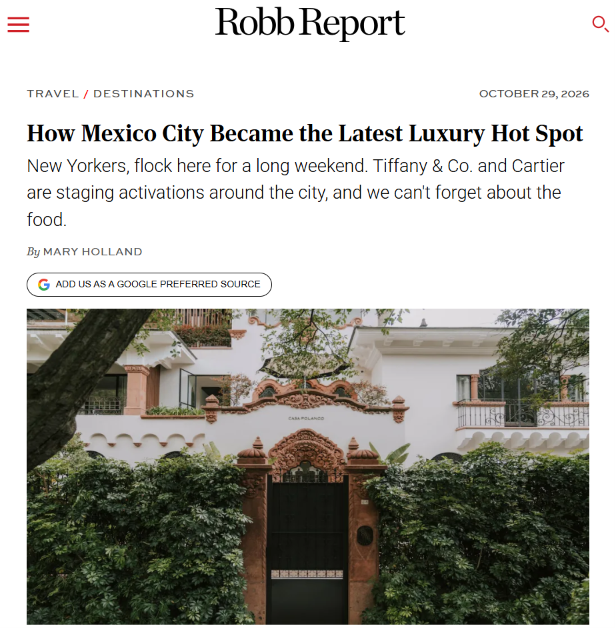
“How Mexico City Became The Latest Luxury Hot Spot” (Robb Report)
Key Takeaways:
Mexico City has emerged as a global luxury travel destination, driven by its growing reputation for world-class gastronomy, art, culture, and design.
Pujol, a renowned restaurant by chef Enrique Olvera, helped transform the perception of Mexican fine dining, putting the city's culinary scene on the international map and inspiring a new generation of ambitious restaurants.
Luxury tourism is rapidly expanding, with approximately 15.5 million hotel visitors in 2025, increasing demand for bespoke experiences and high-end concierge services.
The luxury hospitality scene is evolving, with boutique properties such as Casa Polanco and El Cortés offering personalized stays rooted in Mexican culture and local design.
Luxury retail is gaining momentum, as international brands collaborate with local artists and heritage while homegrown designers and artisanal brands attract affluent international shoppers.
Travelers are increasingly seeking immersive local experiences beyond dining, including contemporary art galleries, architecture, fashion, design boutiques, and cultural events and Mexico City offers it all.
“Prada Hires Veteran Animators For Hand-Drawn Christmas Ads As Coca-Cola Faces AI Backlash” (The Cool Down)
Key Takeaways:
From AI-generated artists to manufactured fan accounts and manipulated streaming numbers, the industry is facing a growing crisis of trust around what's real and what's artificially created.
The controversy surrounding Geese revealed how marketing agencies allegedly used fake fan accounts and coordinated social media campaigns to manufacture the appearance of grassroots excitement.
AI is fundamentally challenging the definition of an artist and the rise of AI-generated musicians, deepfake music videos, and digital artist personas is raising questions about creative ownership, identity, originality, and transparency.
Bot-generated streams are distorting music charts and revenue, prompting platforms to introduce safeguards.
Music creators are increasingly being paid by labels and agencies to promote songs through content that appears to be genuine, independent recommendations.
Despite growing skepticism around digital music culture, fans continue to invest in live concerts, artist connections, and shared experiences that feel real and difficult to manufacture.
“Is 2026 The Fakest Year In Music?” (NPR)
Key Takeaways:
Prada is prioritizing human creativity over AI with its 2026 Christmas campaign, titled “Drawing Prada: Animated By Hand.”
Veteran animator John Pomeroy led the project, bringing decades of traditional animation experience dating back to the 1970s.
Every animated frame is hand-drawn, combining traditional illustration with live-action footage to create a distinctive visual experience.
The campaign reflects growing consumer skepticism toward AI-generated advertising, particularly following Coca-Cola's backlash over its AI-driven holiday campaigns in 2024 and 2025.
Prada is reinforcing its brand identity through craftsmanship, emphasizing the human touch, artistry, and creative process behind its work.
This campaign demonstrates how traditional artistry still resonates across generations, appealing to both audiences who value established craft and younger, digitally savvy consumers.
Looking for 1:1 support on brand strategy & media outreach? Book a complimentary consultation with me here - I’d love to meet you!
Xo,
Julia, Che PR Founder