What we read this week: October 4
“Customers Are Crafting More. Should Brands Get Involved?” (Vogue)
Key Takeaways:
Crafting is becoming a cultural countertrend to digital life, with physical media booming.
Instead of seeing this as lost sales, brands can turn DIY into a new business model and even expand a brand’s customer base.
DIY can be a lower-price entry point into a brand, while preserving what makes their core product special.
Hope Macaulay, for example, is effectively monetizing customer’s desire to make products themselves by selling limited patterns, yarn, and kits.
In-person crafting events give brands a way to create real-world connection and belonging; a community that consumers increasingly crave.
“Verity’s Seductive Home Design Is Made To Pull You In-And Freak You Out” (Architectural Digest)
Key Takeaways:
The house in Verity is essentially a character in the film, not just serving as a backdrop, but a home that carries the story’s psychological tension.
It was found in Armonk, New York and the dramatic gabled roof and walls of glass gave the mysterious, seductive quality that production was looking for.
The interiors use sharp angles, pointed forms, and spiky furniture to create uncomfortableness, instead of a warm, conventional family home.
The architecture reinforces the story’s symbolism, a space that feels glamorous during the day, and threatening at night.
Production designer Amy Williams preserved the distinctive design and exaggerated it by adding stronger verticals and steeper ceiling lines, with the design strategy of seduction and discomfort.
“Holly Can’t Seem To Get The Art World Right” (Vanity Fair)
Key Takeaways:
Films often reduce the art world to easy stereotypes, with pretentious artists, exploitative dealers, and absurd collectors.
This missing complexity is due to many filmmakers lacking experience of making, selling, and living with art.
Art-world satire becomes null, with movies containing enough bitterness to be satirical, but not enough distance to deliver a genuinely sharp critique.
Movies like Showing Up show authentic creativity happening alongside jobs, chores, relationships, and everyday distractions.
The art world is easy to parody, but difficult to portray truthfully and as Hollywood is increasingly fascinated by the contemporary art ecosystem, it remains a question whether filmmakers are able to accurately understand why the art world matters.
“La Arquitectura Secreta De Una Bolsa (The Secret Architecture Of The Bag)” (New York Times Style Magazine: México)
Key Takeaways:
A handbag is both private and public: its exterior communicates taste and identity, while its interior protects the personal objects that make up everyday life.
Materials are central to the design experience as the leather making the bag determines its texture, weight, and longevity.
Construction gives a bag character and the closure is more than a functioning detail, it changes both how the bag functions and how its shape is perceived.
Real luxury is the combination of form and function: the handbag is a piece of portable architecture, with each element determining how the bag performs.
“Every Sandwich On This Menu Will Be The Best One You’ve Eaten All Year” (Feed Me)
Key Takeaways:
From pastrami and Reubens to chopped cheese, or the Italian sub, New York is undeniably a sandwich city, with sandwiches tied to the city’s cultural identity.
East Village is currently the center of sandwich experimentation, and chefs are making exciting new combinations.
Places like Sanwits and Superiority Burger deliberately combine unexpected flavors and cuisines, like fried chicken with shrimp sauce and eggplant aioli.
The best sandwiches aren’t weird for its own sake, they properly balance experimentation with deliciousness.
New York’s sandwich culture is thriving by mixing cuisines, textures and unexpected ingredients to create avant-garde sandwiches.
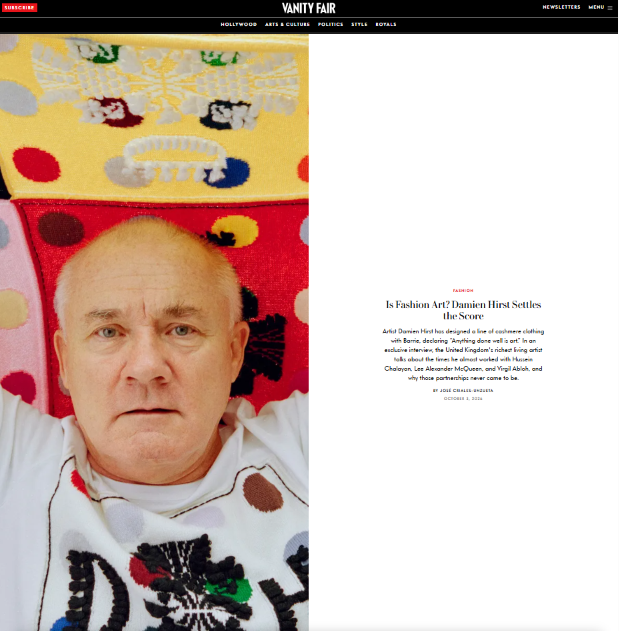
“Is Fashion Art? Damien Hirst Settles The Score” (Vanity Fair)
Key Takeaways:
Damien Hirst is moving further into fashion and has designed a collection of clothes with Bordelle, bringing his recognizable visual language into wearable pieces.
This collaboration blurs the line between art and fashion.
The project treated the clothing itself as a canvas for artistic expression, with Hirst’s signature motifs remaining central.
Hirst challenges the distinction between “high art” and commercial art, giving him a way to explore art as something people can wear and live with.
Hirst’s Bordelle collaboration is not just a fashion side project, it reflects a broader trend where artists and fashion designers blur the boundary between artwork and wearable objects.
Looking for 1:1 support on brand strategy & media outreach? Book a complimentary consultation with me here - I’d love to meet you!
Xo,
Julia, Che PR Founder